Since the launch of Arizona’s Bioscience Roadmap in 2002, the Flinn Foundation has commissioned independent progress assessment of performance measures for the state’s bioscience sector. Data on a consistent set of metrics are gathered and reported publicly every two years.
A Roadmap progress update by TEConomy Partners in April 2025 revealed the following data — the most recent available — on key metrics.
Keep up with industry news with our Arizona Bioscience News newsletter.

Watch the video presentation of the most recent bioscience progress report.
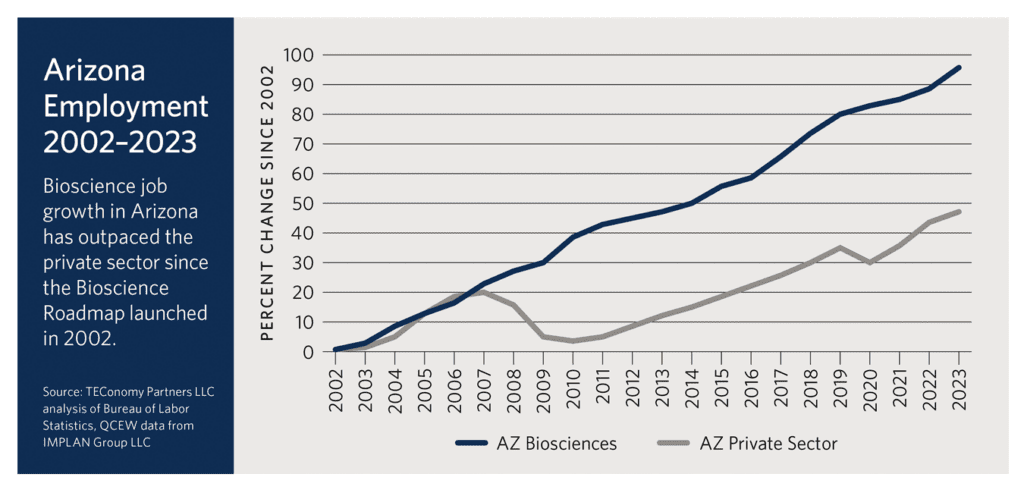
Jobs: Arizona’s most recent bioscience job growth rate from 2020-2023 (8.1%) was higher than the nation’s (6.7%). Non-hospital jobs—about 40,000 of the state’s total 144,000 bio jobs—grew far faster, up 19% over the same period.
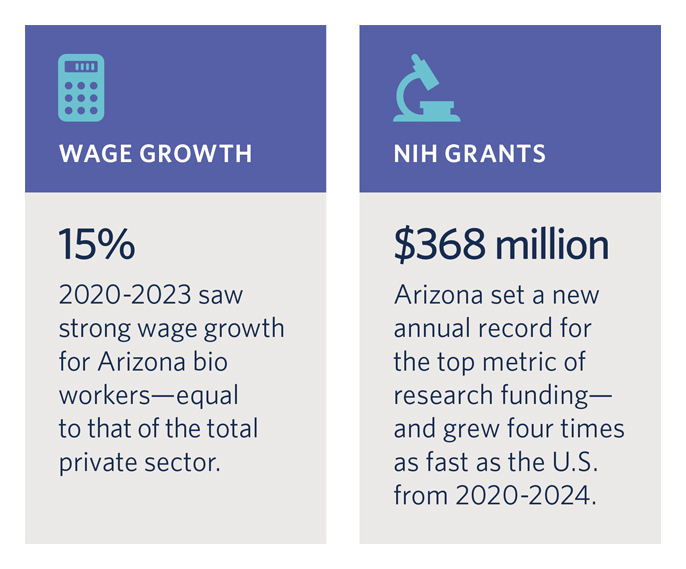
Wages: In 2023, bio workers’ average annual wages were $20,000 above Arizona’s private-sector average. The average wage was $87,000 compared to $67,000. Bio wage growth of 15% generally matched the national rate.
NIH Grants: Arizona received $368 million in grants from the National Institutes of Health in 2024, a new annual record for the key metric of biomedical research funding. Arizona’s growth rate was about four times faster than the U.S. from 2020-24. Arizona’s share of national funding inched up slightly to a record .99%, just shy of the 1% target.
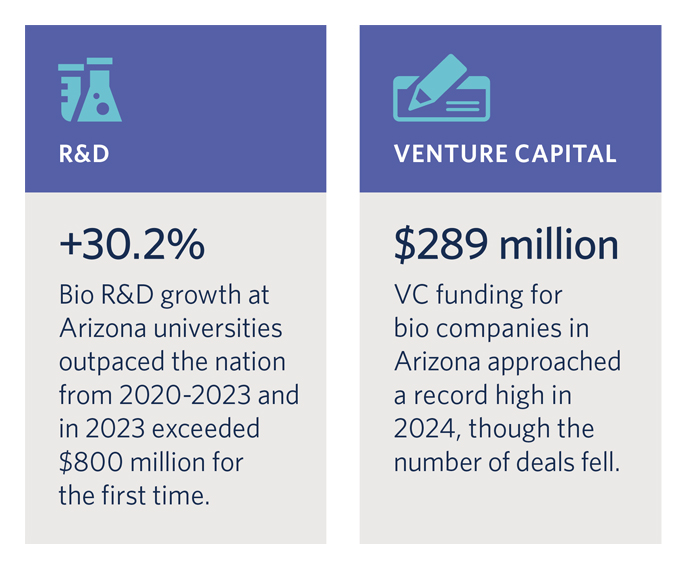
R&D Expenditures: Arizona’s academic research and development expenditures in 2022 reached a record-high $706 million, a steady increase over $642 million in 2021 and $623 million in 2020..
Venture Capital: Venture capital funding for bioscience companies in the state totaled $289 million in 2024, the highest number since 2021’s $291 million. The 50 deals, however, continued a downward trend from 2021’s high of 71, mirroring national trends.
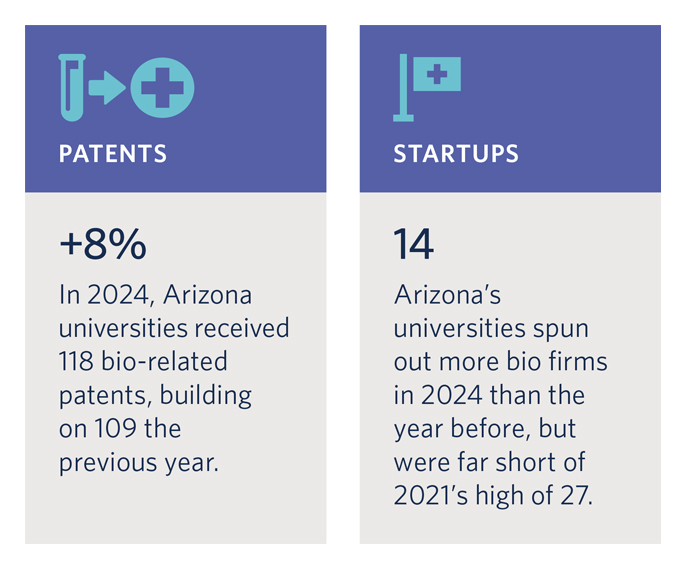
University Tech Transfer: Arizona’s research universities spun out 14 bioscience firms in 2024, two more than the year before. Still, the number was short of 2021’s high of 27.
In April 2025, the Flinn Foundation hosted its annual event to share the new performance data, more than two decades after the launch of Arizona’s Bioscience Roadmap. The latest data can be found in this detailed analysis from TEConomy Partners, “Biosciences in Arizona: 2025 Performance Review.” The report documents another record high in National Institutes of Health funding. It also cites key bioscience advances including a $2 billion investment from Mayo Clinic, a $74.5 million grant awarded for Alzheimer’s research, and the downtown Phoenix location for ASU Health.
The current and past progress reports are available for viewing. In addition, the Foundation tracks the state’s major developments each year.
Data is tracked on the six industry subsectors that comprise Arizona’s definition of the biosciences. It should be noted that the industry data reflect only private industry; research-related jobs at state universities and private research institutions are not incorporated. Also, Arizona’s definition of the biosciences shifted in 2014 to reflect changes in the national definition by Battelle and the Biotechnology Industry Organization. Thus, these industry data do not correlate directly to those from the first decade.
The Flinn Foundation released a new Arizona’s Bioscience Roadmap in September 2025 to guide the state’s bioscience sector through 2030.
Data from earlier years is available on the First Decade page.